Showing posts with label Technical. Show all posts

Monday, May 7, 2012

Epimetheus


Overview:

        I set out to create critical listening speakers that will be enjoyable in any room you put them in. This was accomplished by creating a floor standing pair of speakers with great off axis response to make the largest “sweet spot” to fully enjoy your music. I believe speakers should be flexible enough to be an afterthought when you are relaxing to your favorite music. Epimetheus utilizes a passive 2.5-way crossover design which means, compared to a 2-way crossover, there is an additional woofer that handles only the bass frequency. Features: +/- 2 dB from 70 to 17k Hz Great Off Axis Response Under $800 Floor standing F3: 60 Hz Drivers: Tweeter: The Morel MDT29 was selected for it’s good off axis performance, and low frequency extension that allows it to be crossed over around 1800 Hz Woofer: The Seas L16RN-SL was selected because its Q(tc) indicated it was suited for a sealed box, plus it has good low frequency extension for its size.


Documentation:


Testing Report

Crossover Schematic

Drafting


Testing Results:

Full Range


Purple: Full Range, Red: Tweeter, Blue: Mid-Woofer, Green: .5 Woofer


Full Range, Mid Woofer Inverted


Horizontal Off Axis Response

Purple: 0º, Red: 15º, Green: 30º Blue: 45º, Orange: 60º


Vertical Off Axis Response

Purple: 0º, Red: 15º, Green: 30º, Blue: 45º, Orange: 60º

Harmonic Distortion:


Step Response: 


Impulse Response:


Minimum Phase Response:


Waterfall:


Tweeter Response:


Woofer Response:


  Creative Commons License Epimetheus by Russell Goddard is licensed under a Creative Commons Attribution-NonCommercial-ShareAlike 3.0 Unported License.

Saturday, April 7, 2012

Speaker


This semester I've been designing a pair of speakers. They are a floor-standing (almost 48" tall) and utilize a 2.5 way design, which means that in addition to the normal 2 way design of tweeter and woofer there is an additional woofer that does solely low frequencies.

The drivers I am using consist of the Morel MDT 29 and the Seas L16RN-SL, with a box that is made up of an outer layer of 3/4" Baltic Birch and an inner layer of 1/2" MDF. All told they will weight about 90 lbs.

I think so far they are turning out quite well, the crossover still needs some tweaking, but I can't wait until they are finally finished.


Assembling the side panels.
The basic shape of the box with all the pieces dry fit.
Gluing the front baffle on.
Inside the box, you can see the two braces.

The first iteration of the crossover.
Speaker Testing.

Thursday, November 17, 2011

Orpheum Theater


In May 2011 I started working at the Orpheum Theater in Hancock, MI. It is a old vaudeville theatre that has been renovated and now hosts live music. Initially it used a Yamaha O1V96 digital board, but that soon was replaced by a 48 channel Allen and Heath board.

In addition to running front of house for many of the shows here I also help maintain the system and help book and promote some of the bands that come through here.

The house of the theatre.
Another angle of the stage.


The Allen and Heath board.


Jazz Backstage in the Rozsa


This semester I, along with Spencer Karlovits, was able to record the Jazz Backstage in the Rozsa concert. The concert was much more intimate thanks to the location and the mood was great. There were some issues the first night of the concert, but the second night went smoothly.

For mic placement, most instruments were close miked with the exception of the brass section which were recorded with a stereo pair of Blue Mouse, which you can see in the bottom left picture.


Tutorial Videos

Right now I am currently working on creating 6 tutorial videos along with Tim DeYoung that explain basic aspects of audio software.

The six subjects are:

Logic Basics
Sculpture
Flex Time
Reason
Melodyne
Sink Drive

Fly Covered Candy


In the spring of 2011 I recorded a friends band called Fly Covered Candy they had been playing together a long time and the songwriter was graduating so they wanted to record some of their songs before he left.

So late on a couple of weekends we came in and took over the second floor or the Rozsa Center and set up to record. To try and get as much isolation as possible the guitar and bass amplifiers were spread out through the building, but they were all playing in the same room listening to the mix on headphones. It was decided to overdub the vocals so we wouldn't have to worry about putting the singer in an entirely separate room.


This set up created reasonable isolation, and once the band got use to it created some good takes of their songs.

After the band recorded all the songs and they were roughly mixed the singer was brought in and over two days he overdubbed his vocals. As a spur of the moment decision sometimes the lead guitarist and songwriter would double some of the vocal parts.

Everything was recorded and mixed in Pro Tools.


The rhythm guitarist's amp was put in an
isolation booth.
The lead guitarist's amp was placed in
the hallway.
       
The drummer was placed in the room with all of the
band members.
Another view of the band room, where they recorded.
The bass amp was put in the instrument
room, and was also DI'd.

Ultimate Audio Book System Design


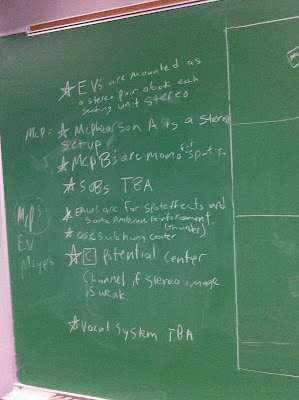
The system design for Ultimate Audio Book was centered around the idea of immersing the audience in the story. To accomplish this we drew up a system design that would surround the audience, and take advantage of our large black box theatre. Shown below is the initial idea and notes, the large rectangles are the seating units, and it is hard to see but the dashed square is the area where the actors would primarily be in for the plays. The speakers in the middle would be hung in the catwalks.


To take advantage of the catwalks that act as a second floor in our black box theatre four more speakers were added, also more speakers were added behind where the actors would be, and the speaker pair that was in front of the seating unit were removed. the location of the sub (QSC on the first draft) was moved and a second one was added to balance the room and help fill the room with low end if the sound designs needed it. The second draft is shown below, the 5x500 speakers are the ones in the catwalks, and the vox speakers are still hung from the catwalks and point at each seating unit.


The final draft of the system added speakers in the seating units, except the seating unit where the sound board and equipment is located, which only had one speaker added. These additional speakers allowed sounds to be placed in seating units when it is needed. The final draft is shown below.


The show used the Yamaha O1V96 digital console and the Eventide Eclipse for vocal effects.

The signal flow is shown below


This system allows the sound to come from anywhere the theatre, sounds can come from above the audience, all around the audience, or from a single location letting the audience feel as though they are in the story world.


This system design received the Certificate of Merit, and won the KCACTF Theatre Craft Showcase.